
Colorado HOA Fining Authority
Section 1: Overview — Fining authority in Colorado
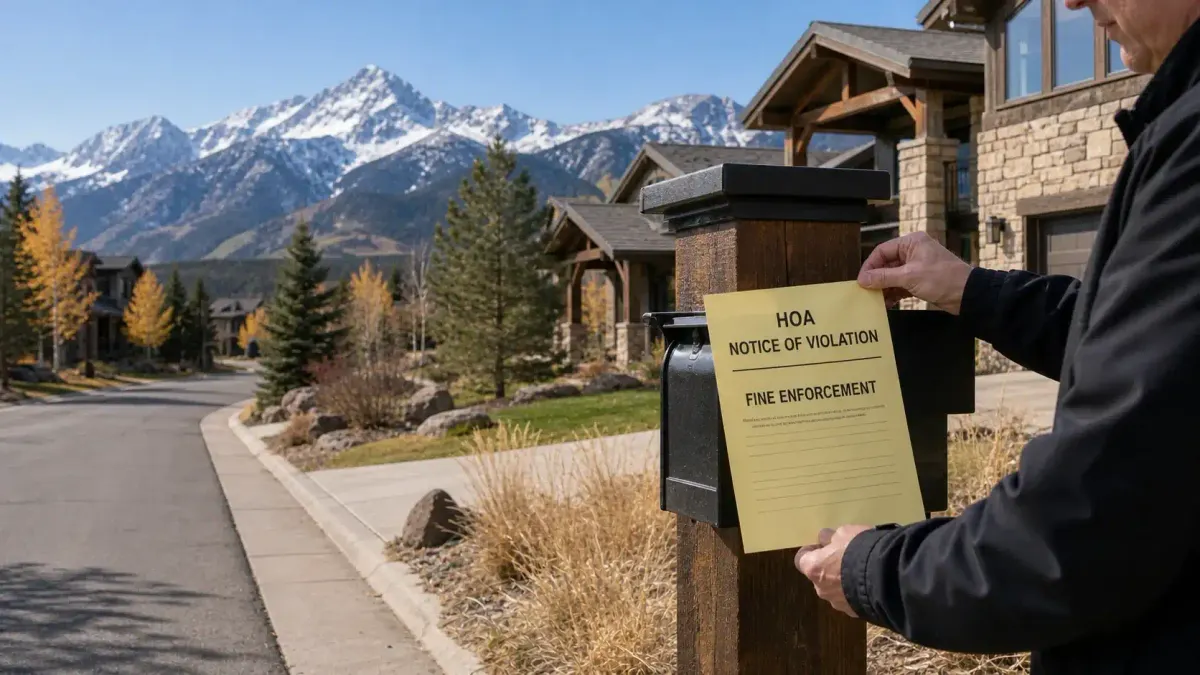
Colorado law gives homeowners associations the power to fine their members. But in 2022, state lawmakers reined that power in. House Bill 22-1137 now requires a written fine policy, demands notice and a chance to fix the problem before any fine lands, caps most fines at a set dollar amount, and generally bars associations from foreclosing over fines and fees alone. The underlying authority to fine comes from the Colorado Common Interest Ownership Act, or CCIOA, which lets an association — after it gives notice and a chance to be heard — levy reasonable fines for violations of the declaration, bylaws, and rules1. HB 22-1137 built detailed procedure and firm limits on top of that authority, and it restricted foreclosure separately, as Section 3 explains2. Since HB 22-1137 took effect, its caps and procedures govern every fining decision. A declaration can add procedures the statute leaves open, but it cannot vary or waive the statutory limits3. That raises the key question: can an unpaid fine become a lien and support foreclosure? The answer is narrow. Fines can attach to the association's statutory lien, but they cannot support foreclosure, and the six-month lien super-priority applies only to common expense assessments, not fines. Section 3C and the table below spell out why4. That table lays out the mechanics at a glance.
Section 2: Quick-Reference Fining Mechanics Table
The table below lays out Colorado's post-HB 22-1137 fining mechanics at a glance. Every value reflects CCIOA as amended by HB 22-1137 (2022) and the legislation that followed it, and Section 3 addresses how the rules reach communities formed before 1992. The detailed discussion that follows sources every figure. CCIOA is a single, unified statute covering condominiums, cooperatives, and planned communities, so the mechanics stay identical across every community type. HB 22-1137's caps and limits control the outcome, and while a declaration can add procedures, it cannot override those statutory limits.
| # | Parameter | Condominiums | Planned Communities |
|---|---|---|---|
| 1 | Statutory fining authority | Yes (§ 38-33.3-302(1)(k)) | Yes (§ 38-33.3-302(1)(k)) |
| 2 | Controlling source | Statute (§§ 302(1)(k), 209.5) plus declaration | Same |
| 3 | Pre-fine notice required | Yes (§ 209.5(1.7)(b)) | Same |
| 4 | Minimum notice or cure period | 30 days (ordinary violation); 72 hours (public-safety/health) (§ 209.5(1.7)(b)) | Same |
| 5 | Opportunity to be heard required | Yes (§ 302(1)(k); fair and impartial fact-finding, § 209.5(2)(b)) | Same |
| 6 | Hearing request or scheduling deadline | Not specified by statute; set by written policy (§ 209.5(2)(c)) | Same |
| 7 | Written notice of decision required | Yes (cure/outstanding-balance notice, § 209.5(1.7)(b)(VI)) | Same |
| 8 | Fine amount standard | "Reasonable"; $500 total cap per ordinary violation; no dollar cap for uncured public-safety/health violations (§§ 302(1)(k), 209.5(1.7)(b)) | Same |
| 9 | Per-day / continuing fines permitted | No daily fines; every-other-day fines only for uncured public-safety/health violations (§ 209.5(1.7)(b)) | Same |
| 10 | Published fine schedule required | Yes; written fine policy required (§ 209.5(2)) | Same |
| 11 | Fines collectible as assessments | No; payments applied first to assessments, then fines/fees (§ 209.5) | Same |
| 12 | Fines securable by association lien | Yes, but restricted; lien allowed, not foreclosable (§ 316(1)(a)) | Same |
| 13 | Fines as basis for foreclosure | Prohibited for fines-only debt (§§ 209.5(8)(c), 316(1)(a)) | Same |
| 14 | Suspension of voting or amenity rights | Declaration-derived; permitted if authorized in governing documents, constrained by § 302.5 | Same |
| 15 | Due-process source | Statutory (§§ 302(1)(k), 209.5(2)) plus declaration | Same |
Values reflect CCIOA as amended by HB 22-1137 (2022). Fine caps and the foreclosure restriction are statutory — confirm current figures against the codified text. The six-month lien super-priority applies to assessments, not fines. Last verified: July 14, 2026.
Section 3: Fining mechanics in detail
3A. Source and outer limits of fining authority
The power to fine starts with the statute, not the declaration. CCIOA authorizes an association — with no need for specific authorization in its declaration — to "impose charges for late payment of assessments, recover reasonable attorney fees and other legal costs for collection of assessments and other actions to enforce the power of the association, regardless of whether or not suit was initiated, and, after notice and an opportunity to be heard, levy reasonable fines for violations of the declaration, bylaws, and rules and regulations of the association"1. That power comes with strings attached: notice, a chance to be heard, and deference to whatever the declaration adds.
Governor Jared Polis signed HB 22-1137 on June 3, 2022, and it took effect that August 105. The bill added three hard limits on top of the base power. First, an association cannot fine any owner unless it has adopted — and actually follows — a written policy governing fines6. That policy must spell out notice describing the alleged violation, the steps needed to cure it, and a timeline for a fair and impartial fact-finding process, and it must state how often the association may levy fines for a continuing violation6. Second, the statute caps most fines: for an ordinary violation — one the association doesn't reasonably determine threatens public safety or health — the total fine for that violation cannot exceed $5006. Third, the association cannot charge late fees or fines on a daily basis6. And interest on unpaid assessments, fines, or fees cannot exceed 8% per year6.
CCIOA reaches condominiums, cooperatives, and planned communities created on or after July 1, 1992. For anything older, § 38-33.3-117 pulls certain sections back to cover them retroactively7. The base fining power in § 302(1)(k) reaches pre-1992 communities through § 117(1)(i), and the lien and foreclosure-restriction section, § 316, reaches them through § 117(1)(k) and § 117(2) — so an association in a pre-1992 community generally cannot foreclose on a fines-only debt, either7. Pre-1992 cooperatives and planned communities with ten units or fewer, and no development rights, are exempt entirely under § 38-33.3-1198. Whether the full § 209.5 procedural fining regime reaches pre-1992 communities is murkier: § 117 enumerates only a narrow slice of § 209.5, so associations in older communities should confirm the point with counsel before they act7. The declaration works alongside the statute — it can add procedures the statute leaves open — but it cannot vary or waive CCIOA's rights3.
3B. The required fining procedure
Since HB 22-1137, an enforceable fine has to follow a defined sequence. The association must first adopt its written fine policy — and actually apply it6. Next comes written notice of the violation and a chance to cure it. For an ordinary violation, the association has to send that notice by certified mail, return receipt requested, in English and in any language the owner has indicated a preference for, telling the owner they have 30 days to fix the problem before any fine follows6. The total fine for that violation still cannot top $500. And before the association can take legal action over the violation, it has to give the owner two consecutive 30-day cure periods6. If the owner cures the violation and sends visual evidence, the violation counts as cured the day the owner sends that notice; if not, the association has to inspect within seven days after the cure period runs out6. Once the violation is cured, the association has to tell the owner that no further fines are coming and state any balance still owed6.
There's a narrow exception for violations the association reasonably determines threaten public safety or health. There, the association gives written notice of just a 72-hour cure period. If the owner hasn't cured within 72 hours after an inspection confirms noncompliance, the association may impose fines every other day and take legal action — though it still cannot pursue foreclosure based on fines owed6. That's the only setting where continuing fines are allowed at all, and even then only every other day, never daily, and without the $500 cap.
An owner's right to be heard runs through the fair and impartial fact-finding process the written policy must describe6. The statute sets no specific deadline for requesting or scheduling that hearing — the association's own written policy fixes that interval. Here's the practical stake: since HB 22-1137, a fine imposed without the written policy, the cure opportunity, and the required notice is open to challenge, and an association that skips a step may lose the ability to recover related attorney fees, which are not recoverable for work performed before the association complies with the § 209.5(1.7)(a) notice requirements4. Trial-level disputes proceed in the Colorado District Courts, and certain governing-document disputes up to $7,500 may go to small claims court instead6. Appeals head to the Colorado Court of Appeals, with discretionary review from the Colorado Supreme Court.
3C. Enforcement of unpaid fines: assessments, liens, and foreclosure
Unpaid fines are not collectible as assessments. HB 22-1137 requires an association to apply an owner's payments first to unpaid assessments and only then to unpaid fines, fees, or charges, and it treats fines separately from common expense assessments for enforcement purposes2. The association does hold a statutory lien on a unit "for any assessment levied against that unit or fines imposed against its unit owner," but fees, charges, late charges, attorney fees, fines, and interest "may be subject to a statutory lien but are not subject to a foreclosure action" under CCIOA4. So a fine can attach as a lien. It just cannot be foreclosed on its own.
The six-month super-priority belongs to assessments, not fines. CCIOA's association lien outranks a first mortgage, but only to the extent of the common expense assessments — based on the periodic budget adopted under § 38-33.3-315(1) — that would have become due during the six months immediately preceding the foreclosure action4. That super-priority window is defined entirely by assessments. It does not extend to fines, and a fine-only balance does not prime a first mortgage.
HB 22-1137 also restricts foreclosure directly. An association may not foreclose on an assessment lien if the debt securing the lien consists only of fines, or of collection costs or attorney fees associated only with assessed fines6. To foreclose, the balance of assessments and charges secured by the lien must equal or exceed six months of common expense assessments based on the periodic budget, and the executive board must formally resolve, by a recorded vote, to authorize the filing against the specific unit on an individual basis. The board cannot delegate that vote, and courts must dismiss any action filed without evidence of the recorded vote4. Before foreclosing, the association must also work through the § 209.5 and § 316.3 collection steps, including a written offer of an 18-month repayment plan with minimum payments of at least $25 per month9.
Suspension of voting rights or amenity use is not a statutory fining remedy — it is declaration-derived. An association may suspend an owner's voting rights or common-area use for delinquency or a violation only if its governing documents grant that authority, and § 38-33.3-302.5 now constrains even that authority: the association must preserve owners' access to and enjoyment of common elements, and it may not impose unreasonable restrictions10.
Section 4: Recent legislative and judicial activity
A. Recent bills
HB 22-1137 · 2022 Regular Session
This is the law that now governs fining authority in Colorado. It rewrote the state's fining and collection rules — requiring a written fine policy, imposing pre-fine notice and cure periods, capping ordinary fines at $500 per violation, barring daily fines, capping interest at 8% per year, requiring an 18-month payment-plan offer before foreclosure, and prohibiting foreclosure on a debt made up solely of fines and related costs.[2]
| Property managers | Rebuild your fine and collection policies around the written-policy, notice, and cure requirements — skip a step and the action can be voided and fee recovery forfeited. |
| HOA board members | The board must approve collection referrals and foreclosure filings by recorded vote, and it cannot fine above the $500 cap for ordinary violations. |
| Community association attorneys | Confirm strict statutory compliance before any lien or foreclosure step, and advise clients that fines-only debt cannot support foreclosure. |
| Homeowners | Owners now get multiple notices, cure periods, and a payment-plan offer — and they cannot lose the home to foreclosure over fines alone. |
HB 24-1233 · 2024 Regular Session
This bill dropped the requirement to physically post a delinquency notice on the unit. It requires the association to make contact through two methods, not one, chosen from telephone, text, or email, on top of certified mail. It lets associations bill owners for the cost of certified-mail notices. And it exempts timeshare units that are not occupied full-time from certain requirements.[11]
| Property managers | Update your delinquency workflow to drop door-posting and add a second electronic or telephone contact method. |
| HOA board members | Confirm the association keeps current owner phone numbers and email addresses on file to satisfy the two-method contact rule. |
| Community association attorneys | Verify notice-method compliance before referral — defective contact can undermine collection down the line. |
| Homeowners | Owners now hear about a delinquency through multiple channels, and may get billed for certified-mail costs. |
HB 24-1337 · 2024 Regular Session
Senate President Pro Tem James Coleman and Senator Tony Exum sponsored this bill, and Governor Jared Polis signed it in early June 2024. It caps recoverable attorney fees in collections at $5,000 or 50% of the original money owed, whichever is less, adjusted annually for inflation under § 38-33.3-123. It adds a pre-foreclosure mediation notice. It requires a personal judgment, with limited exceptions, before an association can foreclose on a principal residence. And it creates a 180-day right of redemption after a foreclosure sale, with a notice of intent to redeem due within 30 days of the sale.[12]
| Property managers | Budget for capped fee recovery, and build the mediation-notice step into your pre-foreclosure timeline. |
| HOA board members | Know that foreclosing on an owner-occupied home now generally requires a personal judgment first. |
| Community association attorneys | Reassess foreclosure strategy in light of the fee cap, the mediation notice, and the extended redemption window. |
| Homeowners | Owners gain a mediation option, a fee-recovery cap, and a 180-day redemption right after a sale. |
HB 25-1043 · 2025 Regular Session
This bill raised the bar from substantial compliance to strict compliance. It added pre-foreclosure disclosures — a ledger on request within seven business days, an equity-loss warning, and HUD credit-counseling resources. It authorized courts to stay a foreclosure that does not comply. And it added delinquency and foreclosure data to the annual DORA registration.[13]
| Property managers | Any deviation from the statute or the governing documents can now stay a foreclosure, so procedural precision is not optional. |
| HOA board members | Update collection policies and registration reporting, and expect courts to scrutinize strict compliance. |
| Community association attorneys | Advise clients that even minor noncompliance can halt a foreclosure and bar fees during a stay. |
| Homeowners | Owners gain ledger transparency, equity protection, and a stronger basis to challenge a defective foreclosure. |
B. Recent appellate rulings
No published Colorado appellate opinion from the past 36 months squarely takes on HOA fine enforceability, HB 22-1137, due process in fine imposition, or how the lien and foreclosure rules treat fines. Two recent CCIOA opinions from the Colorado Court of Appeals do touch association law, but neither concerns fining. In Willis v. Twin Shores Master Owner Association, Inc., 2025 COA 37, the court addressed whether a guest injured in the common elements counts as an invitee for premises-liability purposes; the Colorado Supreme Court granted certiorari on January 12, 2026 (No. 25SC286) on the reframed question of "whether the division erred in holding that as to an association, a unit owner's guest is afforded invitee status under the Premises Liability Act, section 13-21-115, C.R.S. (2025), in areas that are part of the common elements"14. In Frisco Lot 3 LLC v. Giberson Limited Partnership, LLLP, 2024 COA 125, the court asked whether a pre-CCIOA subdivision had created a binding common interest community15. Neither case decides a fining question, so the current fining regime rests on the statute, not on recent case law.
C. Active legislative debates
The 2026 session's HOA activity centered on reserve funding, foreclosure-data implementation, and homeowner insurance — not fine caps. Lawmakers postponed indefinitely a bill that would have narrowed the non-English notice accommodation, HB 26-120116. No 2026 measure changed the fine cap, the cure periods, or the foreclosure restriction.
Section 5: National positioning and related coverage
Colorado belongs to the UCIOA family of states, alongside Alaska and Connecticut — but it has layered some of the most owner-protective limits in the country onto that base statutory fining power, through HB 22-1137 and the bills that followed in 2024 and 2025. That is a different posture from CC&R-primary states like Arkansas, or Alabama's planned-community regime, where fining authority flows mainly from the recorded declaration. It is different, too, from Arizona's procedurally specific framework, built around statutory notice-and-hearing rules. Colorado's $500 ordinary-fine cap, 8% interest ceiling, mandatory 18-month payment-plan offer, and general bar on foreclosing for fines alone make it one of the most regulated fining environments in the United States. Multi-state operators need Colorado-specific procedure here, not a generic template. The six-month lien super-priority reaches only assessments — a fine-only balance can never support foreclosure.
HOA Weekly updates this Colorado Fining Authority coverage quarterly, as the legislature and the Colorado courts act, with particular attention to how HB 22-1137 is implemented and amended. Federal frameworks apply on top of the state framework regardless — notably the FDCPA, which can reach third-party collection of fines, along with the FHA, ADA, SCRA, and OTARD.
Footnotes
- Colorado General Assembly, Office of Legislative Legal Services, Colo. Rev. Stat. § 38-33.3-302(1)(k)(I), Powers of unit owners' association, 2024 CRS Title 38 ↩
- Colorado General Assembly, HB 22-1137, Homeowners' Association Board Accountability and Transparency, bill page and official summary ↩
- Colorado General Assembly, Office of Legislative Legal Services, Colo. Rev. Stat. § 38-33.3-104, Variation by agreement (CCIOA rights may not be varied by agreement or waived) ↩
- Colorado General Assembly, Colo. Rev. Stat. § 38-33.3-316(1)(a), (2)(b)(I), (7)(b), (11)(a), Lien for assessments — liens for fines, fees, charges, costs, and attorney fees — limitations, as amended by HB 22-1137 (signed act) ↩
- Orten Cavanagh Holmes & Hunt, LLC, "HB 22-1137 Signed Into Law" (Governor Polis signed HB 22-1137 on June 3, 2022; effective August 10, 2022) (cross-verification of signing and effective dates) ↩
- Colorado General Assembly, Colo. Rev. Stat. § 38-33.3-209.5, Responsible governance policies — due process for imposition of fines — procedure for collection of delinquent accounts — enforcement through small claims court, as enacted by HB 22-1137 (signed act), subsections (1.7)(b), (2), (8)(c), and (9) ↩
- Colorado General Assembly, Office of Legislative Legal Services, Colo. Rev. Stat. § 38-33.3-117, Applicability to preexisting common interest communities (§ 117(1)(i) applies § 302(1)(k); § 117(1)(k) and (2) apply § 316), 2024 CRS Title 38 ↩
- Colorado General Assembly, Office of Legislative Legal Services, Colo. Rev. Stat. § 38-33.3-119, Exception for small preexisting cooperatives and planned communities (10 units or fewer, no development rights), 2024 CRS Title 38 ↩
- Colorado General Assembly, Colo. Rev. Stat. §§ 38-33.3-209.5(7) and 38-33.3-316.3(2), 18-month repayment plan offer with minimum monthly installments of at least $25, as enacted by HB 22-1137 ↩
- Colorado General Assembly, Office of Legislative Legal Services, Colo. Rev. Stat. § 38-33.3-302.5, Unit owners' access to common elements — duties of association — unreasonable restrictions and prohibitions prohibited, 2024 CRS Title 38 ↩
- Colorado General Assembly, HB 24-1233, HOA Delinquency Payments Enforcement Procedures, bill page and official summary (signed June 3, 2024; effective August 7, 2024) ↩
- Colorado General Assembly, HB 24-1337, Real Property Owner Unit Association Collections, bill page and official summary (attorney-fee cap of $5,000 or 50% of the original money owed; 180-day right of redemption with 30-day notice of intent; mediation notice; personal-judgment requirement); signed June 5, 2024 ↩
- Colorado General Assembly, HB 25-1043, Owner Equity Protection in HOA Foreclosure Sales, bill page and official summary (strict-compliance standard; ledger within 7 business days; equity-loss warning; credit-counseling disclosure; annual registration data); effective October 1, 2025 ↩
- Colorado Supreme Court, Case Announcements, Willis v. Twin Shores Master Owner Association, Inc., 2025 COA 37; certiorari granted January 12, 2026, No. 25SC286 ↩
- Colorado Court of Appeals, Case Announcements, Frisco Lot 3 LLC v. Giberson Limited Partnership, LLLP, 2024 COA 125 ↩
- Colorado General Assembly, 2026 regular session bill records (HB 26-1201 postponed indefinitely; 2026 HOA activity centered on reserve funding, foreclosure data, and homeowner insurance) ↩