
Florida HOA Foreclosure
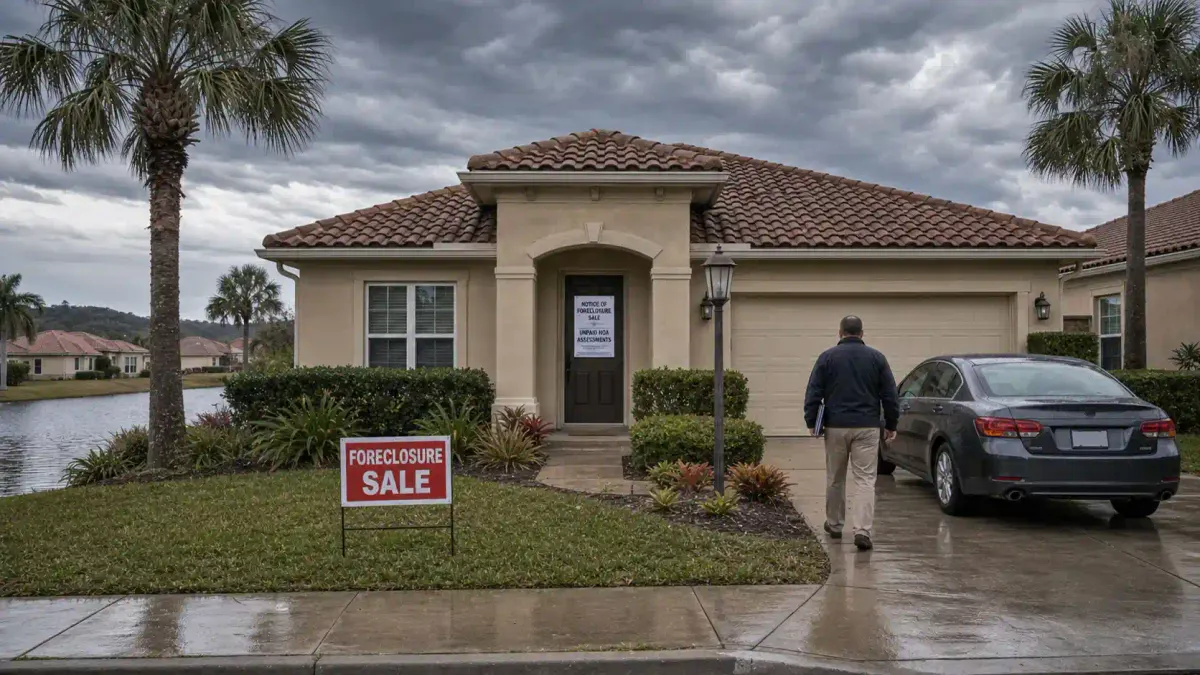
Section 1 — Overview: How HOA foreclosure works in Florida
Florida regulates association assessment-lien foreclosure through two parallel statutes, and every foreclosure moves through the Circuit Court as a judicial proceeding.1,2,3 The Florida Condominium Act, Chapter 718, governs condominiums. The Florida Homeowners' Association Act, Chapter 720, governs HOAs. The two chapters run side by side, and they are not identical.1,2 Fla. Stat. § 718.116 supplies the lien provisions for condominium associations, § 720.3085 does the same for HOAs, and § 718.121 sets out the condominium lien-recording mechanics separately.1,2,4 Both chapters now require a 45-day written notice of intent to record a claim of lien before an association may record one — condominiums under § 718.121(6), HOAs under § 720.3085(4). Senate Bill 56 (Ch. 2021-91, Laws of Florida) raised the condominium period from 30 to 45 days; the governor signed it June 16, 2021, and it took effect July 1, 2021, lining condominium and cooperative owners up with the 45-day period that homeowners'-association parcel owners already had.2,4,5 Florida's defining feature is the "safe harbor." It caps a first mortgagee's liability for a prior owner's unpaid assessments at the lesser of 12 months of unpaid common expenses and regular periodic assessments or 1 percent of the original mortgage debt — condominiums under § 718.116(1)(b), HOAs under § 720.3085(2)(c).1,2 Florida is judicial-only. No trustee's sale, power-of-sale, or other non-judicial procedure exists to foreclose an association lien.1,2,3 The post-Surfside laws — SB 4-D in the 2022 Special Session, SB 154 in 2023, HB 1021 in 2024, and HB 913 in 2025 — do not touch foreclosure procedure. What they do is mandate milestone inspections, structural integrity reserve studies, and reserve funding, and those requirements create the financial pressure that drives delinquency and, in turn, foreclosure.6,7,8,9,10 Florida holds roughly 20 percent of all U.S. condominiums — more than 1.5 million units, or one of every five condos in America, according to Census Bureau data analyzed by the University of Florida's Warrington College of Business — so procedural precision in foreclosure is a direct liability concern for managers and boards.11
Section 2 — The statutory framework
2A. The condominium lien under Chapter 718
The Florida Condominium Act gives every condominium association a lien on each parcel to secure unpaid assessments under § 718.116(5)(a), and § 718.121 governs the recording mechanics.1,4 The lien relates back to the recording of the original declaration of condominium. But as to first mortgages of record, it takes effect only when the association records a claim of lien in the public records of the county where the parcel sits (§ 718.116(5)(a)).1 The lien secures unpaid assessments, interest, administrative late fees, and the reasonable costs and attorney fees the association incurs in collection (§ 718.116(5)(b)).1 A valid claim of lien has to state the parcel description, the record owner's name, the association's name and address, the amount due, and the due dates, and an officer or authorized agent must execute and acknowledge it (§ 718.116(5)(b)).1
Three notice steps gate condominium collection. First, before attorney fees can attach, the association must deliver a 30-day notice of late assessment under § 718.121(5).4 Second, it cannot record a lien until 45 days after it delivers a notice of intent to record a claim of lien — sent by registered or certified mail, return receipt requested, plus first-class mail — under § 718.121(6); that period was 30 days until Senate Bill 56 (Ch. 2021-91) raised it, effective July 1, 2021.4,5 Third, no court may enter a foreclosure judgment until at least 45 days after the association gives written notice of intent to foreclose under § 718.116(6)(b), and an association that skips that notice cannot recover attorney fees and costs if the owner pays before final judgment.1
The safe harbor in § 718.116(1)(b) caps what a first mortgagee — or its successor or assignee — owes for a prior owner's unpaid assessments when it takes title by foreclosure or deed in lieu. The cap is the lesser of (a) the unit's unpaid common expenses and regular periodic assessments that accrued in the 12 months immediately before it acquired title, or (b) 1 percent of the original mortgage debt.1 The cap applies only if the first mortgagee joined the association as a defendant in the foreclosure action.1 Beyond the safe-harbor amount, the association lien sits junior to a recorded first mortgage, so a first-mortgage foreclosure ordinarily wipes out the association's claim against the unit except for the capped sum. A claim of lien lasts no longer than one year after recording unless the association starts an enforcement action within that year (§ 718.116(5)(b)), and any bankruptcy automatic stay tolls the period.1
2B. The HOA lien under Chapter 720
The Florida Homeowners' Association Act gives an HOA a lien on each parcel — when the governing documents authorize it — to secure assessments and other amounts under § 720.3085(1).2 As with condominiums, the lien relates back to the recording of the original declaration but, as to first mortgages of record, takes effect only when the association records a claim of lien (§ 720.3085(1)).2 The lien secures unpaid assessments accruing through entry of a certificate of title, plus interest, late charges, and reasonable costs and attorney fees (§ 720.3085(1)(a)).2 A valid claim of lien must state the parcel description, the record owner's name, the association's name and address, the assessment amount due, and the due date (§ 720.3085(1)(a)).2
An HOA cannot record a lien until it delivers a written notice or demand giving the owner 45 days to pay, sent by registered or certified mail, return receipt requested, plus first-class mail, under § 720.3085(4).2 A separate 30-day notice of late assessment is required under § 720.3085(3)(d) before the association charges attorney fees.2 The HOA then cannot file a foreclosure action until 45 days after it gives the owner notice of intent to foreclose under § 720.3085(5).2
The HOA safe harbor in § 720.3085(2)(c) mirrors the condominium cap: a first mortgagee that takes title by foreclosure or deed in lieu owes prior-owner assessments only up to the lesser of (1) unpaid common expenses and regular periodic or special assessments accrued in the 12 months immediately before it acquired title, or (2) 1 percent of the original mortgage debt — and only if it joined the association in its foreclosure action.2 The main differences from Chapter 718 are structural. The HOA lien depends on authorization in the governing documents, the HOA chapter ties the lien to a recorded declaration and the parcel's chain of covenants, and Chapter 720 carries a detailed "qualifying offer" mechanism (§ 720.3085(6)) that lets an owner stay the foreclosure for up to 60 days to pay.2 Chapter 720 also lacks the express one-year lien-enforcement deadline that § 718.116(5)(b) sets; courts instead apply the general five-year limitations period of § 95.11 to HOA lien foreclosure.2
2C. Judicial foreclosure procedure and federal/state overlays
Every association lien foreclosure proceeds judicially through the Circuit Court in the manner of a mortgage foreclosure under Fla. Stat. Chapter 702 (§ 702.01 et seq.); both statutes expressly direct the court to foreclose the lien "in the manner a mortgage of real property is foreclosed" (§ 718.116(6)(a); § 720.3085(1)(c)).1,2,3 The case runs through a complaint, a recorded lis pendens, service of process, an answer, summary judgment or trial, and a clerk's judicial sale that ends in a certificate of title. Cooperatives fall under Chapter 719, which likewise requires judicial foreclosure.
Several federal and state overlays attach. The federal Fair Debt Collection Practices Act (15 U.S.C. § 1692 et seq.) reaches pre-foreclosure dunning by third-party collectors and association law firms. Because Florida is judicial-only, the Supreme Court's narrow holding in Obduskey v. McCarthy & Holthus LLP, which addressed Colorado's non-judicial foreclosure, does not exempt Florida association foreclosure firms from the full reach of the FDCPA.12,13 The Florida Consumer Collection Practices Act (Fla. Stat. § 559.55 et seq.) goes further than the FDCPA, because its prohibited-practices section, § 559.72, applies to "any person" collecting a consumer debt — including original creditors — and Florida courts have held that condominium assessments are consumer debt.14 The Servicemembers Civil Relief Act (50 U.S.C. § 3901 et seq.) requires a court order before anyone forecloses against the property of a covered servicemember whose obligation predates service, and it allows stays (50 U.S.C. § 3953).15 The bankruptcy automatic stay (11 U.S.C. § 362) halts foreclosure the moment an owner files and tolls the association's lien-enforcement deadline.16 Paid community association managers must hold a license under Fla. Stat. § 468.431 et seq. once the association exceeds 10 units or a $100,000 annual budget.17
Section 3 — The procedural sequence
A. Lien establishment and priority
A condominium lien arises by statute and attaches when an assessment becomes due, relating back to the recorded declaration, under § 718.116(5)(a); an HOA lien attaches the same way when an assessment becomes due, where the governing documents authorize it, under § 720.3085(1).1,2 In both chapters the lien secures unpaid assessments plus interest, late fees, collection costs, and attorney fees (§ 718.116(5)(b); § 720.3085(1)(a)).1,2 As to a recorded first mortgage, neither lien takes effect until the association records a claim of lien, so the association's lien sits junior to a prior first mortgage. Florida grants no UCIOA-style super-priority; the safe harbor caps the lender's liability when the lender takes title rather than priming the mortgage.1,2 Recording the claim of lien in the county public records perfects the lien against first mortgagees and is a prerequisite to foreclosure.
B. Pre-lien notice and cure period
For condominiums, the association must first deliver the 30-day notice of late assessment under § 718.121(5) if it wants to recover attorney fees, then a 45-day notice of intent to record a claim of lien under § 718.121(6), delivered by registered or certified mail with return receipt requested and by first-class mail; the condominium pre-lien period stayed at 30 days until Senate Bill 56 (Ch. 2021-91) raised it to 45 days, effective July 1, 2021.4,5 For HOAs, the parallel obligations are the 30-day notice of late assessment under § 720.3085(3)(d) and the 45-day notice of intent to record a claim of lien under § 720.3085(4).2 These notices give the owner a window to cure — to pay everything due before the association records a lien. When a third-party collector or law firm handles the matter, the FDCPA validation notice and the FCCPA's broader prohibitions overlay these state notices.13,14 Condominium lien foreclosure is exempt from the Chapter 718 pre-suit alternative dispute resolution requirement, so no mandatory mediation or arbitration comes before the action.
C. Foreclosure sale procedure
Before filing, the association must give the pre-foreclosure notice of intent to foreclose — 45 days for condominiums under § 718.116(6)(b) and 45 days for HOAs under § 720.3085(5).1,2 The association then files a judicial foreclosure complaint in Circuit Court, records a lis pendens, serves the owner and junior lienholders, and moves toward summary judgment or trial. After judgment, the clerk runs the judicial sale — typically an online auction — and issues a certificate of sale, then a certificate of title to the high bidder. The association may credit-bid, and it may buy the parcel at its own foreclosure sale and then hold, lease, mortgage, or convey it (§ 718.116(6)(d); § 720.3085(1)(f)).1,2 If a servicemember whose obligation predates active duty occupies the unit, SCRA compliance requires a court order and may entitle the servicemember to a stay (50 U.S.C. § 3953).15 No non-judicial or trustee's-sale procedure exists for association liens in Florida.1,2
D. Post-sale rights and safe harbor
When a first mortgagee, rather than the association, forecloses and takes title, the safe harbor caps its liability for the prior owner's assessments at the lesser of 12 months of unpaid common expenses and regular periodic assessments or 1 percent of the original mortgage debt (condominiums under § 718.116(1)(b); HOAs under § 720.3085(2)(c)), provided the association was joined as a defendant.1,2 Whoever acquires title must pay that amount within 30 days of transfer (§ 718.116(1)(c)).1 Florida distributes surplus funds from a judicial sale under Fla. Stat. § 45.032, which pays subordinate lienholders who timely claim before it pays the former owner of record; a first mortgage that survives an association foreclosure is not a subordinate lien and does not share in the surplus.18 A mortgagor or junior interest holder may cure and stop the sale before the certificate of sale issues, under the limited right of redemption in § 45.0315.19 Deficiency judgments are available in Florida mortgage-type foreclosures under § 702.06, though associations more often seek a money judgment or take title.20 Once title transfers, the new owner may pursue eviction, or, if the former owner stays, the court may require payment of reasonable rent (§ 718.116(6)(c); § 720.3085(1)(e)).1,2
Section 4 — Recent legislative and judicial activity
A. Recent bills
Florida's recent legislative activity has not rewritten foreclosure procedure. Instead, it has stacked on inspection, reserve, and governance duties that raise the assessments owners owe — and those, in turn, feed delinquency and foreclosure.
HB 1021 · 2024 Regular Session
This act amended Chapter 718 to expand official-records obligations, require director education, mandate quarterly board meetings in larger associations, add criminal penalties for kickbacks and records violations, and broaden the DBPR Division's jurisdiction. It is not a foreclosure statute, but its compliance and reserve-related burdens add the financial pressure that feeds delinquency.[8]
| Property managers | New recordkeeping, website-posting, and CAM records-return duties carry per-day penalties; keep collection files audit-ready. |
| HOA board members | Director certification and quarterly financial reporting raise governance exposure, and reserve obligations compound delinquency risk. |
| Community association attorneys | Expanded DBPR jurisdiction and criminal provisions reshape advice on records and conflicts during collection. |
| Homeowners | Wider records access and account detail give you more ways to verify or contest what the association claims you owe. |
HB 913 · Ch. 2025-175 · 2025 Regular Session
This act refined the post-Surfside framework: it extended the structural integrity reserve study deadline, allowed a two-year pause on reserve contributions to prioritize milestone repairs, raised the reserve cost threshold from $10,000 to $25,000, and added online registration and competitive-bidding requirements. Again, it does not change foreclosure procedure, but it directly affects the special-assessment pressure that drives owner delinquency.[9]
| Property managers | Reserve-pause and registration mechanics change cash-flow planning and the state reporting that feeds collection decisions. |
| HOA board members | Relief provisions may ease sudden special assessments and lower near-term delinquency, but reserve funding stays mandatory. |
| Community association attorneys | New disclosure, bidding, and termination provisions affect how you counsel on the assessments that underlie liens. |
| Homeowners | A short reserve pause may slow assessment spikes, but the dollars subject to future collection can still climb. |
SB 4-D & SB 154 · 2022 Special Session & 2023 Regular Session
SB 4-D created the statewide milestone inspection program (Fla. Stat. § 553.899) and the structural integrity reserve study requirement; SB 154 refined inspection timing and reserve-waiver restrictions. Neither changes foreclosure procedure, but both drive the special assessments that lead to delinquency and foreclosure.[6],[7],[10]
| Property managers | Inspection and reserve deadlines generate large assessments that increase delinquency volume. |
| HOA board members | Reserve-waiver restrictions remove the option to defer funding, raising owner cost burdens. |
| Community association attorneys | The foreclosure connection here is financial pressure, not procedural change — counsel accordingly. |
| Homeowners | Mandatory inspections and reserves can mean sharp new assessments, and unpaid ones can lead to a lien. |
B. Recent appellate rulings
Two recent appellate decisions turn on precision. One holds that defective pre-suit notice sinks a five-figure foreclosure; the other holds that an association cannot collect an assessment it adopted after it filed suit.
Winston Towers 100 Association, Inc. v. Antonioli
A condominium association sued to foreclose a claim of lien for more than $45,000 in past-due assessments and maintenance fees, plus interest and attorney fees, against a Sunny Isles Beach unit owner in Miami-Dade Circuit Court. The Third DCA affirmed judgment for the unit owner, because the association could not prove it delivered the required pre-suit notice of intent to record a claim of lien — it had mailed the notices to addresses that were not the unit address, and the owner denied any connection to them.[21]
| Property managers | Mail every notice to the correct address of record and keep provable proof of mailing — defective notice voids the recovery. |
| HOA board members | A single misstep on notice can defeat a five-figure collection and shift fees back to the association. |
| Community association attorneys | Document and prove each statutory notice; mailing-procedure testimony from a knowledgeable witness is essential. |
| Homeowners | If the association did not properly notify you, improper notice is a real defense to the foreclosure. |
Orfanos v. 45 Ocean Condominium Association, Inc.
The Fourth DCA held that a special assessment the association adopted after it filed the foreclosure complaint could not go into the final judgment, because an after-adopted assessment is not one that "accrued" within § 718.116(5)(b). To recover it, the association must amend its complaint or its claim of lien.[22]
| Property managers | The amounts you demand in a lien foreclosure must track what the lien and pleadings actually secured. |
| HOA board members | A new special assessment adopted mid-litigation does not automatically join the judgment. |
| Community association attorneys | Amend the complaint or claim of lien to capture post-filing assessments. |
| Homeowners | You can challenge any amount in a foreclosure that the association added after it filed suit. |
C. Active legislative debates
Florida lawmakers keep weighing further condominium relief — measures that try to balance structural-safety funding against owner affordability. Proposals to refine reserve-funding timelines and the My Safe Florida Condominium grant program remain on the table as the 30-year inspection cohort grows.
Section 5 — National positioning and related coverage
Florida sits apart from the super-priority states on lien priority. It is not a UCIOA jurisdiction. Its safe harbor caps a foreclosing lender's liability for prior-owner assessments at the lesser of 12 months of assessments or 1 percent of the original mortgage debt, rather than priming the first mortgage — unlike the six-month super-priority in Alaska, Colorado (Colo. Rev. Stat. § 38-33.3-316), Delaware, and the District of Columbia, or the nine-month super-priority in Connecticut (Conn. Gen. Stat. § 47-258) and Nevada (Nev. Rev. Stat. § 116.3116).1,2 On method, Florida is judicial-only through the Circuit Court, like Connecticut and Delaware, and unlike the non-judicial regimes in Arizona, California, and Colorado.1,2,3 The safe harbor itself is a distinctive Florida feature — it works as a liability cap, not a priority rule. On pre-lien notice, Florida now requires 45 days for both condominiums and HOAs, longer than the 30-day pre-lien notice generally tied to California's Davis-Stirling Act.2,4 For multi-state operators, post-Surfside Florida is the highest-anxiety market: reserve-driven special assessments and dense high-rise inventory make procedural precision in foreclosure a frequent, high-stakes obligation.
Florida foreclosure compliance comes down to running two parallel statutes correctly, honoring every 45-day notice, and respecting the lesser-of safe-harbor cap — because a single missed step can void a foreclosure or trigger FDCPA, FCCPA, or SCRA exposure for the manager and the board.
- Fla. Stat. § 718.116 (2025), Assessments; liability; lien and priority; interest; collection ↩
- Fla. Stat. § 720.3085 (2025), Payment for assessments; lien claims ↩
- Fla. Stat. ch. 702 (§ 702.01 et seq.), Foreclosure of mortgages, agreements for deeds, and statutory liens ↩
- Fla. Stat. § 718.121 (2025), Liens (45-day notice of intent to record claim of lien at subsection (6)) ↩
- S.B. 56, Ch. 2021-91, Laws of Fla. (2021) (signed June 16, 2021; effective July 1, 2021; raising condominium and cooperative pre-lien notice period from 30 to 45 days) ↩
- S.B. 4-D, Ch. 2022-269, Laws of Fla. (2022 Special Session) (milestone inspections; structural integrity reserve studies) ↩
- S.B. 154, Ch. 2023-203, Laws of Fla. (2023) (building safety amendments) ↩
- H.B. 1021, Laws of Fla. (2024), Condominium and Cooperative Associations (effective July 1, 2024) ↩
- CS/CS/H.B. 913, Ch. 2025-175, Laws of Fla. (2025) (effective July 1, 2025) ↩
- Fla. Stat. § 553.899, Mandatory structural inspections for condominium and cooperative buildings ↩
- Found. for Cmty. Ass'n Research, 2020 U.S. National and State Statistical Review (Florida holds approximately 20% of all U.S. condominiums, more than 1.5 million units, per Census Bureau data analyzed by the University of Florida Warrington College of Business) ↩
- Obduskey v. McCarthy & Holthus LLP, 586 U.S. 466 (2019) (Colorado non-judicial foreclosure; FDCPA scope) ↩
- Fair Debt Collection Practices Act, 15 U.S.C. § 1692 et seq. ↩
- Fla. Stat. § 559.55 et seq. (Florida Consumer Collection Practices Act); prohibited practices at § 559.72 ↩
- Servicemembers Civil Relief Act, 50 U.S.C. § 3953, Mortgages and trust deeds (court order required; stays available) ↩
- 11 U.S.C. § 362, Automatic stay ↩
- Fla. Stat. §§ 468.431, 468.432, Community association manager licensing ↩
- Fla. Stat. § 45.032, Disbursement of surplus funds after judicial sale ↩
- Fla. Stat. § 45.0315, Right of redemption ↩
- Fla. Stat. § 702.06, Deficiency decree; common-law suit to recover deficiency ↩
- Winston Towers 100 Ass'n, Inc. v. Antonioli, No. 3D24-1077 (Fla. 3d DCA Nov. 26, 2025) ↩
- Orfanos v. 45 Ocean Condo. Ass'n, Inc., 368 So. 3d 995 (Fla. 4th DCA Aug. 2, 2023), No. 4D22-1877 ↩